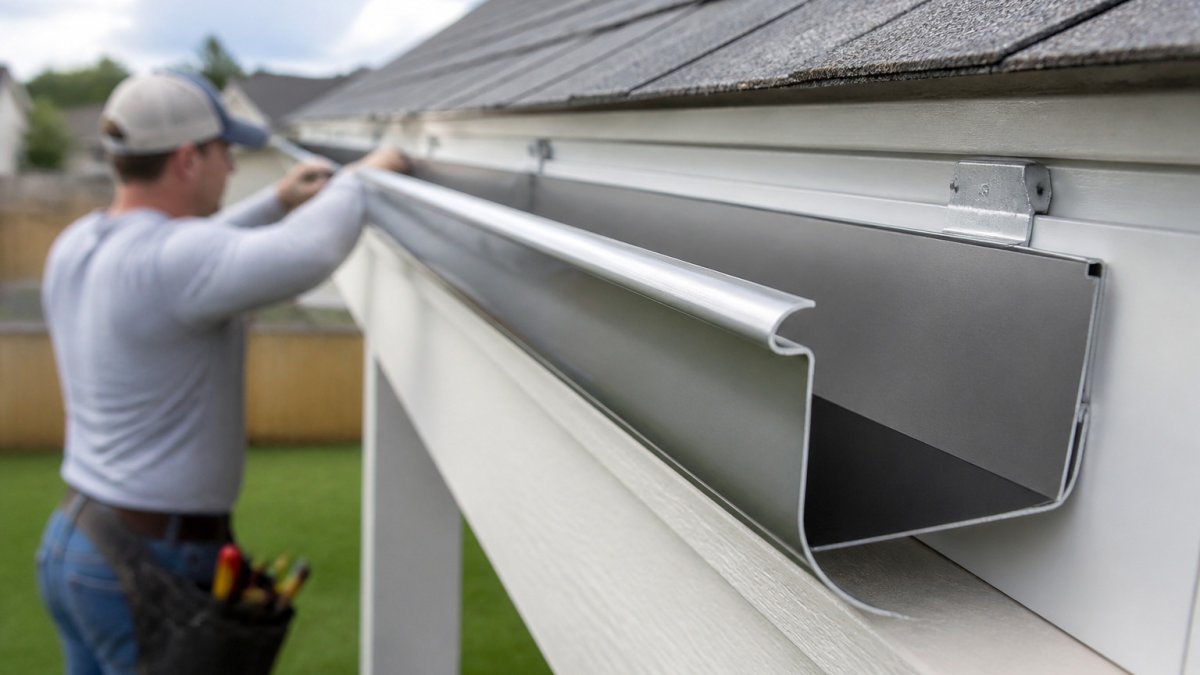
 comparison
7 Seamless Gutter Facts Before You Pay Extra
Last Updated: November 4, 2026
Quick Summary
Seamless gutters are worth the extra cost when your current sectional system already has failing joints or leaks, or when you plan to stay in the home for many years. Their main advantage is fewer seams, which means fewer places for leaks to develop, though they still need regular cleaning.
- Check your current gutter joints first; separating or dripping joints strengthen the case for seamless.
- Seamless systems have fewer seams, which are where leaks usually start as sealant dries out.
- Break-even depends on how long you plan to own the home and your joint and water-damage repair history.
- Seamless gutters still need cleaning at least twice a year, more often under overhanging trees.
- Require an itemized written quote covering footage, gauge, downspouts, removal and both warranties.
Table of Contents
- Seamless Gutters vs. Regular Gutters: What Actually Differs
- What Seamless Gutters Cost in the US Today
- Seamless Gutter Pros and Cons
- Break-Even Math: When the Extra Cost Pays Off
- Seamless Gutter Maintenance and Where Systems Fail
- Choosing the Right Setup for Your Roof and Climate
- Getting an Itemized Quote Before You Commit
- Frequently Asked Questions
Seamless Gutters vs. Regular Gutters: What Actually Differs
Seamless gutters are formed from a single continuous run of metal, usually aluminum, rolled on site to fit your roofline. Sectional gutters come in pre-cut lengths of about 10 feet and are joined together with brackets, sealant and fasteners at every connection. That difference in joints drives most of the comparison, which is why homeowners searching for a seamless gutter installation often want to know whether the premium pays off.
The practical differences are easy to check. Seamless systems have fewer seams, and seams are where leaks usually start as sealant dries out and joints shift with temperature. Sectional systems can be cheaper to buy and easier for a handy homeowner to install, but they require more inspection of those joints over time. Our advice is to look at the joints on your current system before deciding anything: if they are already separating or dripping, the case for seamless is stronger.
What Seamless Gutters Cost in the US Today
Seamless gutter pricing varies by house, region and material.

Your own quote should break these figures out line by line: linear footage, material gauge, downspout count, removal of old gutters, and any repairs to fascia or soffit. Ask whether the price includes haul-away and whether the installer will pay for damage found during removal. Pricing depends on the specifics of your home, so use these ranges as a starting point rather than a final number, and check current local rates with contractors in your area.
Seamless Gutter Pros and Cons
Pros:
- Fewer seams, so fewer places for leaks to develop
- Fits your roofline in one continuous run
- Lower routine maintenance than systems with many joints
- Seamless systems can offer a longer service life than sectional systems
Cons:
- Higher upfront cost than sectional systems
- Installation needs a crew with the right equipment, so you cannot easily do it yourself
- Still needs regular cleaning, since seamless gutters clog with debris just like any other type
- Limited benefit if your current system is in good shape and the budget is tight
On a tight budget, sectional gutters may be the more practical choice. The seamless premium is a trade-off, not a universal upgrade.
Break-Even Math: When the Extra Cost Pays Off
A break-even test only works if you put real numbers on both sides of the ledger. The upfront premium is the easy half: seamless systems cost more than sectional systems, and the gap grows with the linear footage of the home.
The other half of the ledger is what the premium is supposed to buy: fewer joint failures, less resealing, and less water where it does not belong. Build the comparison around three cost buckets you can actually estimate.
- Joint maintenance and resealing. Sectional systems have a joint roughly every 10 feet, plus fasteners and sealant at each connection. Sealant dries and joints shift with temperature, so resealing is a recurring task. Price it as your own time plus sealant, or as a handyman visit if you do not climb a ladder.
- Leak and overflow repairs. The common repairs are resealing or replacing a joint, re-pitching a sagging run, reattaching hangers pulled from fascia, and replacing a crushed downspout. Ask a local contractor what each of those costs on your home; the numbers vary too much by market to import from a national guide.
- Water-damage remediation. This is the bucket that decides the math, and it is also the one with the widest range. Fascia and soffit repair, soil erosion at the foundation, and basement or crawlspace moisture are all plausible outcomes of a gutter that fails in the wrong place. Foundation repair costs vary enormously, so do not anchor on a single figure. Instead, use your own repair history and your inspector's notes as the baseline.
Then run the comparison over realistic ownership periods rather than a single year. If you plan to stay five years and have never had a gutter-related repair, the break-even case is weak. If you plan to stay fifteen years, have mature trees over the roofline, and have already patched fascia once, the premium has more room to pay for itself.
Watch out: a break-even calculation that assumes seamless gutters never leak will overstate the case. Seamless runs still have joints at inside and outside corners and at every downspout outlet, and a long custom run that is damaged in one spot may need a spliced repair or a full replacement of that run. Build a plausible repair into the seamless side of the ledger too, or the comparison is rigged.
A defensible way to present the math to yourself is a simple table: upfront premium in one column, estimated joint maintenance plus a probability-weighted repair allowance in the other, multiplied by the years you expect to own the home. If the premium column is larger and your current system is sound, sectional is the rational choice. If the maintenance and repair column is larger, the seamless premium is doing real work.
The article breaks the cost comparison into three buckets you can estimate for your own home.
| Cost bucket | What it covers | How to estimate |
|---|---|---|
| Joint maintenance and resealing | Sealant, joint shifts, recurring resealing | Your own time plus sealant, or a handyman visit |
| Leak and overflow repairs | Resealing joints, re-pitching runs, reattaching hangers, replacing downspouts | Local contractor quotes for your home |
| Water-damage remediation | Fascia, soffit, soil erosion, basement or crawlspace moisture | Your repair history and inspector notes |
Seamless Gutter Maintenance and Where Systems Fail
Seamless gutters require less joint maintenance, but they are not maintenance-free. Clean them at least twice a year, more often if you have overhanging trees, and check that downspouts drain away from the foundation. Look for sagging sections, which can signal a bracket failure or a clog holding water in the trough.
The most common failures are clogs that overflow, improperly sloped runs that pool water, and downspouts that discharge too close to the house. Fasteners can also pull loose from fascia over time, especially in heavy storms. Gutter guards can reduce debris buildup, though they add cost and need their own upkeep. Regular inspection catches these problems early, when repairs are inexpensive. Our article on signs of improper gutter installation lists seven red flags to recognize before a bad install causes damage.
Choosing the Right Setup for Your Roof and Climate
The right gutter setup depends on your roof pitch, roof area, rainfall intensity and home layout. A steep roof sheds water quickly and can overwhelm undersized gutters, so downspout size and count matter. Our guide to gutter installation for heavy rain walks through seven steps for setups that hold up in heavy downpours. In areas with heavy seasonal rain, a larger gutter profile and more downspouts usually perform better than a standard setup. In drier climates, the seam advantage matters less, and the decision leans more on cost.
If your home has multiple roof sections that drain into the same run, plan for the combined flow, not just the largest section. A reputable installer should walk the roofline with you and explain the sizing. If they cannot explain why a particular size and downspout layout suits your home, that is a reason to ask more questions.
Getting an Itemized Quote Before You Commit
Most gutter bids are one number on a page, which makes them impossible to compare. Our gutter installation service page lays out what an itemized request covers before you commit. The fix is to require an itemized written estimate and to know what the line items should say. This is the part of the decision the top-ranking pages tend to skip, so treat it as your checklist.
What the quote should itemize. Linear footage by run; gutter profile size and material; metal gauge or thickness; number and location of downspouts; number of corners and outlets; hanger type and spacing; removal and haul-away of the old system; fascia or soffit repair allowance; and warranty terms for both materials and workmanship. If a bid omits removal or disposal, assume it is extra and ask for it in writing.
Installation-quality checks that separate bids. These are the details that determine whether a seamless system performs like the premium product you paid for:
- Gauge and material. Aluminum is the common choice; ask for the gauge in writing and confirm it matches what the bid says. Thinner metal dents and oil-cans more easily.
- Hanger spacing. Hangers set too far apart let the run sag and pool water. Ask what spacing the installer uses and whether hangers are hidden or exposed.
- Slope. Gutters need a slight pitch toward the downspouts. A run installed dead level holds water and grows algae and mosquitoes.
- Downspout sizing and discharge. Confirm the count, the size, and where the water lands. Discharge too close to the foundation defeats the purpose of the system.
- On-site fabrication. Seamless gutters are rolled to length at the house. Ask whether the crew fabricates on site and how they handle corners and downspout outlets, since those are the joints that remain.
- Warranty split. Workmanship and material warranties are separate. Get both in writing.
DIY sectional versus professional seamless. The trade-off is real and worth pricing explicitly. Sectional gutters are sold in pre-cut lengths and can be installed by a capable homeowner with basic tools, which is why the material cost is lower. Seamless requires a roll-forming machine, a truck to carry it, and a crew that can handle long runs on a roof, so it is not a realistic DIY project for most homeowners. If you are comparing a DIY sectional bid against a professional seamless bid, put a value on your own labor and on the risk of a poorly pitched run, then compare the totals.
Before you sign. Confirm the contractor is licensed and insured, ask for the certificate of insurance, and check that the quote names the disposal and any fascia repair allowance. If you want help reviewing a bid or planning an installation, you can request a quote from SunPro Contracting LLC for an itemized estimate tailored to your home. For a deeper look at preventing damage, our guide on preventing water damage from gutters covers the warning signs to watch for.
Frequently Asked Questions
Are seamless gutters worth the extra cost?
For many homes, yes, but it depends on the property. Seamless systems generally cost more upfront than sectional gutters, but they have fewer joints that can leak. The payoff is strongest when a home has a long ownership horizon, heavy rain, or a history of seam leaks and foundation drainage problems. If the budget is tight or the home will be sold soon, sectional gutters may be the more practical choice. Ask a contractor to quote both options so you can compare the actual numbers for your house.
Are seamless gutters more expensive than sectional gutters?
Yes, seamless gutters generally cost more upfront than sectional gutters. Pricing varies by material, linear footage, and installation complexity, so pricing depends on the specifics of your home. Request an itemized quote from SunPro Contracting LLC for an accurate comparison.
Do seamless gutters leak less than regular gutters?
Seamless gutters have fewer joints, and manufacturers and installers commonly argue that this reduces leak points. Sectional gutters rely on connected sections and sealed seams that can separate over time, especially with freeze-thaw cycles and heavy debris loads. The available sources do not provide independent leak-rate data, so the benefit is well supported in principle but not quantified. Proper installation and regular cleaning matter as much as the system type.
How long do seamless gutters last?
Seamless gutters can last longer than sectional gutters, though lifespan is an estimate. Lifespan depends heavily on the material, typically aluminum or steel, the local climate, and maintenance. Clearing debris, checking fasteners and seals, and addressing sagging sections early all extend service life. Treat any single lifespan figure as an estimate and ask your installer about warranty terms.