 how-to
Emergency Commercial Roof Repair Services: What to Do Now
Table of Contents
- What Counts as a Commercial Roofing Emergency
- Signs You Need Emergency Roof Repair Right Now
- Commercial Roof Leak Detection and Assessment
- Emergency Roof Tarping Services and Temporary Solutions
- The Commercial Roof Insurance Claim Process
- What to Do During a Roofing Emergency: Your Action Plan
- Preventing Future Emergencies With Maintenance
- Conclusion
- Frequently Asked Questions
Last Updated: September 20, 2026
What Counts as a Commercial Roofing Emergency
Emergency commercial roof repair becomes necessary when a commercial roofing emergency threatens structural integrity, poses immediate safety risks, or allows water intrusion that damages inventory, equipment, or operations. These situations demand urgent attention within hours, not days.
Common scenarios include active leaks during heavy rain, large sections of roofing material blown away by storms, visible ponding water, or structural damage visible from inside. Active water entry threatens HVAC systems, electrical infrastructure, and stored goods.
Signs You Need Emergency Roof Repair Right Now
Visible water stains spreading across ceiling tiles indicate active water intrusion into occupied spaces.
Dripping water inside during or after rain signals active water penetration. Faster dripping indicates a larger breach.
Sagging roof sections indicate structural compromise or failed drainage and pose a collapse and safety hazard.
Visible cracks, splits, or separation in roofing membrane material, particularly around seams and flashing, are water entry points.
Debris scattered across the roof or parking lot means your roof system is actively failing and can't protect what's underneath.
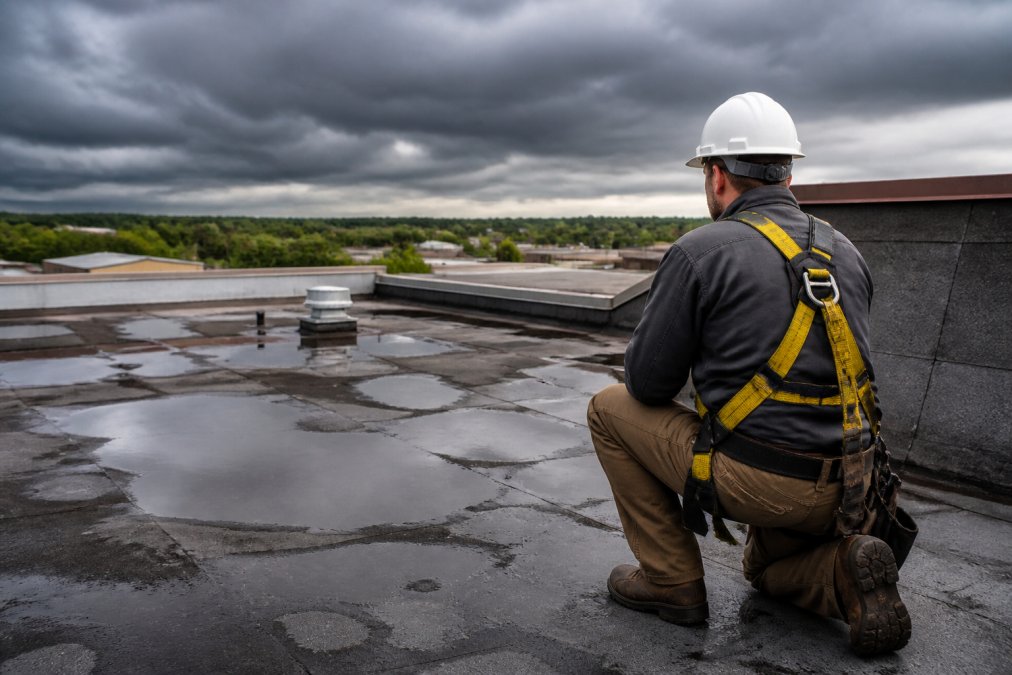
If your building has a flat roof and you notice areas where water pools and sits (rather than draining), that's a drainage system failure. Standing water eventually finds its way through even intact membrane material.
Commercial Roof Leak Detection and Assessment
Professional leak detection begins with visual inspection of the roof surface and interior spaces. A technician traces water's path along structural members, insulation layers, or membrane surfaces.
Thermal imaging or moisture meters identify trapped water before visible stains appear, preventing mold, insulation degradation, and structural rot.
Document the damage location and size, roofing material type (TPO, EPDM, PVC, or built-up), system age, and water intrusion extent. Take photos and video for your insurance claim.
Emergency Roof Tarping Services and Temporary Solutions
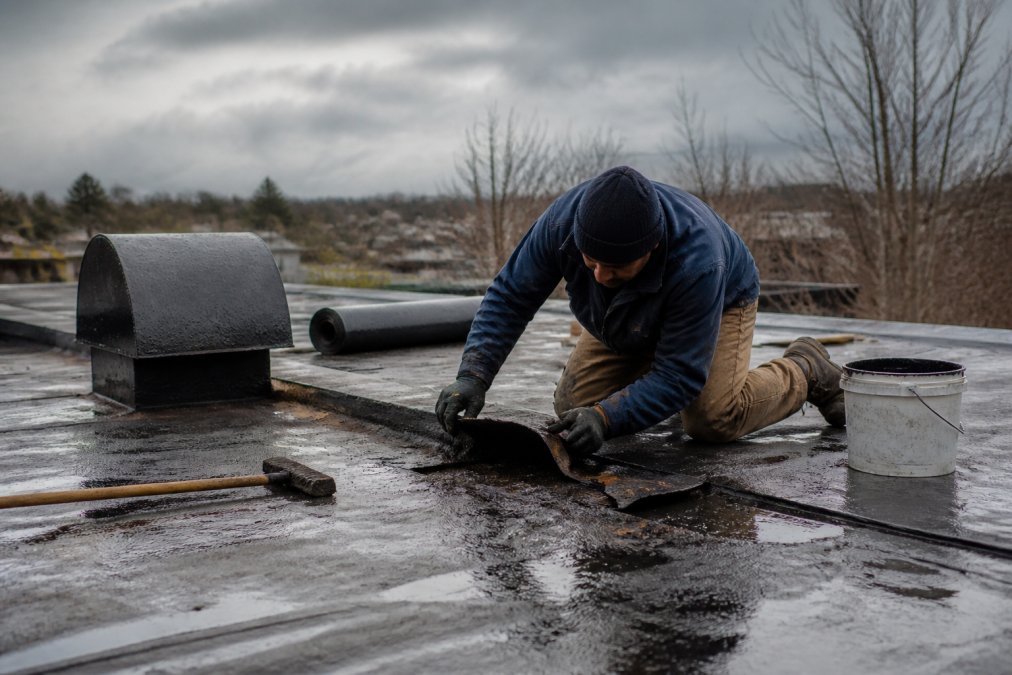
Tarping is the immediate temporary fix for large roof openings or missing sections. A properly installed tarp covers the damaged area and diverts water until permanent repairs are made.
Emergency tarping involves securing heavy-duty plastic or vinyl sheeting (6-10 mil thickness) over the damaged section, extending 6-10 feet beyond the perimeter. Installation typically takes 2-4 hours depending on roof size, accessibility, and weather.
When to Choose Tarping vs. Patching
Tarping is appropriate for large damage areas (typically 50+ square feet), missing sections of membrane, or damage affecting multiple roof zones. It's also the right choice when structural damage is visible or when the damage location makes patching ineffective, for example, damage near seams or flashing where water will find alternate entry points around a patch.
Patching works for smaller, isolated holes (typically under 20 square feet) away from seams and penetrations, sealed in 30 minutes to 1 hour if the underlying membrane is intact.
Cost and Timeline Factors for Emergency Tarping
Emergency tarping costs typically range from $500-$2,500 depending on roof size and damage extent, with after-hours emergency response adding 50-100% above standard rates.
Tarping is temporary. Permanent repair should follow within 7-14 days; leaving a tarp longer than two weeks risks wind damage, UV degradation, and water seeping under edges.
Documentation During Temporary Repair
Document the temporary repair with photos showing tarp installation, damage covered, and interior water intrusion before tarping to establish baseline damage and prove mitigation efforts.
Keep tarping invoices separate from permanent repair invoices, as emergency mitigation costs are often covered separately with different deductibles.
The Commercial Roof Insurance Claim Process
Call your insurance company immediately after discovering emergency damage. Most policies require notification within 24-48 hours. Provide the damage date, description, scope, and mitigation steps taken to establish your claim number and start adjuster assignment.
Documentation: What Adjusters Actually Need
Adjusters evaluate claims based on evidence that damage occurred, was caused by a covered peril (storm, wind, hail, or sudden failure, not wear and tear), and your response was reasonable and timely.
Photograph and video the damage from multiple angles before any cleanup or repairs begin. Adjusters need to see:
- The roof surface showing the damage location, size, and type (missing membrane, torn flashing, structural deformation)
- The damage perimeter and surrounding intact roof area (to establish the scope)
- Interior water intrusion, stains, and affected materials (to prove water actually entered the building)
- Damaged contents, equipment, or inventory (if applicable)
- Weather conditions at the time (wet surfaces, debris, visible storm damage to surrounding structures)
Note the date, time, and weather conditions when discovered. If damage occurred during a storm, record storm type, wind speed, and visible evidence (debris, fallen branches, hail marks) to establish causation from a covered peril.
Professional Assessment: Your Strongest Evidence
Request a detailed written assessment from your roofing contractor including damage location and dimensions, type and cause, roofing system type and age, photographic evidence with measurements, and repair options with cost estimates.
Professional assessments carry significant weight with adjusters because they're expert documentation of whether damage was caused by a covered peril or pre-existing conditions.
Detailed Estimate: The Basis for Your Claim
Get a detailed estimate itemizing materials, labor, equipment, additional repairs, and required permits and inspections.
This itemized estimate becomes the basis for your insurance claim. Adjusters compare estimates against their cost databases; detailed, professional estimates support your claim amount.
Do not submit a lump-sum estimate. Adjusters need line-item detail to evaluate reasonableness and process the claim accurately.
Emergency Mitigation Costs
Keep all receipts and invoices related to emergency response, tarping, water removal, temporary measures, and contents protection (moving equipment, placing catch buckets, running dehumidifiers). These are claimable expenses under emergency mitigation or loss mitigation provisions in commercial policies.
Include invoices for:
- Emergency tarping or temporary repair
- Water extraction and drying services
- Temporary containment materials
- Equipment rental (dehumidifiers, fans, pumps)
- Contents relocation or protection
- Any professional assessment or inspection fees
Filing the Claim: Presentation Matters
File your claim with all documentation organized and clearly labeled:
- A written summary (1 page) describing the damage, how it occurred, the date and time, and your immediate response
- Timeline of events (discovery → emergency call → tarping → adjuster notification → assessment)
- Photos and video with captions identifying what each image shows and when it was taken
- Adjuster's inspection report (once available)
- Contractor's detailed assessment and estimate
- Receipts and invoices for emergency mitigation
- Weather service data or news reports confirming the storm event (if applicable)
Common Claim Denials and How to Avoid Them
What to Do During a Roofing Emergency: Your Action Plan
Step 1: Ensure Safety and Evacuate if Necessary If structural damage is visible or water is actively dripping into occupied spaces, move people away from the affected area. Falling debris, electrical hazards from water contact, and mold exposure are real risks. Don't wait for permission, prioritize immediate safety.
Preventing Future Emergencies With Maintenance
Professional inspections twice yearly identify membrane damage, flashing issues, drainage problems, and material degradation before they become emergencies.
Conclusion
Emergency commercial roof repair demands immediate action to prevent cascading damage. Water intrusion spreads, damages hidden systems, and creates conditions for mold and structural failure.
| Emergency Response Step | Timeline | Action |
|---|---|---|
| Safety assessment and evacuation | Immediate | Move people away from damage area |
| Emergency repair call | Within 30 minutes | Contact 24/7 contractor |
| Water containment | Within 1 hour | Move equipment, place catch buckets |
| Damage documentation | Within 2 hours | Take photos, video, notes |
| Insurance notification | Within 24 hours | Report claim, request adjuster |
| Professional assessment | Within 24 hours | Get detailed damage report |
| Temporary repair (tarping) | Within 24-48 hours | Secure damaged area |
| Permanent repair scheduling | Within 48 hours | Arrange full repair timeline |
Frequently Asked Questions
What constitutes a commercial roofing emergency?
A commercial roofing emergency includes active water intrusion into occupied spaces, structural damage from storms or high winds, roof punctures or tears exposing interior areas, complete system failure affecting building operations, or damage that threatens employee safety or property. Water actively dripping into work areas, visible structural sagging, or damage affecting HVAC systems or electrical equipment all require immediate attention. The key is whether the damage prevents normal business operations or creates safety hazards.
How quickly should you respond to a commercial roof leak?
Contact a commercial roofing contractor within hours of discovering a leak, not days. Water intrusion spreads rapidly through structural materials, insulation, and interior spaces, causing mold growth, electrical hazards, and equipment damage that compounds repair costs. Many commercial property managers report that delays of even 24 hours resulted in secondary damage requiring much larger repairs. Emergency dispatch services can typically assess and begin temporary mitigation (such as emergency roof tarping) the same day.
Does commercial property insurance cover emergency roof repairs?
Most commercial property insurance policies cover emergency roof repairs caused by sudden events like storms, wind damage, or hail, but coverage depends on your specific policy and the cause of damage. Wear-and-tear or lack of maintenance typically are not covered. Document all damage with photos before any repairs begin, and contact your insurance agent immediately. Provide your contractor with your policy details so they can help coordinate the claims process and ensure proper documentation for your commercial roof insurance claim process.
How can I prevent emergency roof repairs with regular maintenance?
Schedule professional roof inspections twice yearly (spring and fall) to identify small problems before they become emergencies. Clear debris from roof surfaces and drainage systems regularly to prevent water pooling and membrane deterioration. Have flashing, seals, and penetrations checked and resealed as needed. For flat roofs, ensure proper drainage and monitor for ponding water. A preventative maintenance program catches issues like membrane wear, coating degradation, and drainage blockages early, avoiding costly emergency repairs and extending roof system lifespan.