 blog
SunPro Florida: Roofing, Painting, and Gutter Services
Last Updated: November 28, 2026
Quick Summary
SunPro in Florida is best known for exterior shade and enclosure products, retractable awnings, motorized screens, and patio and lanai shade systems, sold and installed for homes and light-commercial properties. Installation, measurement, and service come from the same company that sells the product, which matters when a motor or fabric panel needs attention later.
- Retractable awnings come in manual crank and motorized versions run by wall switch or remote.
- Openness factor is the percentage of open weave and determines how a screen performs.
- Ask a roofing contractor for their state license number and insurance certificate before signing.
- A fair roofing estimate prices decking repair per sheet upfront rather than leaving it open.
- Let a wet awning dry fully extended before retracting it to avoid mildew.
Table of Contents
- What does SunPro Florida offer homeowners and property managers?
- Questions to ask a roofing contractor before you sign
- A roofing estimate checklist that protects your budget
- How to compare roofing contractors without getting burned
- Roofing contractor credentials and insurance: what to verify
- Why SunPro Florida fits Central Florida homes and businesses
- Request your free estimate from SunPro Contracting
- Frequently Asked Questions
What does SunPro Florida offer homeowners and property managers?
SunPro in Florida is best known for exterior shade and enclosure products, retractable awnings, motorized screens, and patio and lanai shade systems, sold and installed for homes and light-commercial properties.
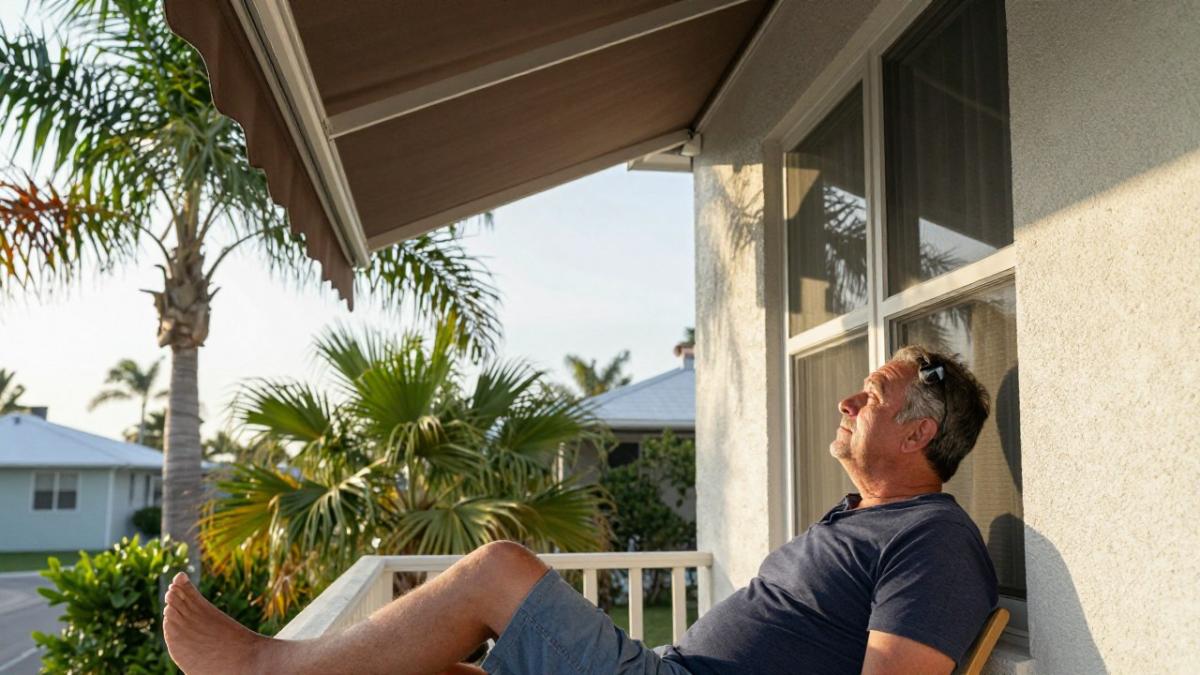
Retractable awnings
A retractable awning is a fabric canopy on a folding arm frame that mounts above a patio door, window, or deck and rolls back into a cassette or open roll when not in use. Units come in manual (crank) and motorized versions, the latter run by wall switch or remote. Fabric is usually solution-dyed acrylic or vinyl-laminated polyester; acrylic breathes better and resists fading, while vinyl sheds water more aggressively but traps heat.
Motorized screens
Motorized screens are the other half of the shade equation: a fabric panel on a roller that drops or slides across a porch, lanai, garage bay, or window wall and stops on command. Sun screens block a percentage of solar heat and glare while preserving the view; privacy screens are woven tighter; insect screens prioritize airflow and bug exclusion. Openness factor, the percentage of open weave, is the number to ask about, because a 5% screen performs very differently from a 10% or 14% screen.
Patio, lanai, and porch shade
The same product family covers the spaces people actually use: a covered patio that gets too much western sun, a lanai unusable in July, a porch that collects leaves and rain. Awnings handle overhead sun; screens handle side-driven sun, wind-blown rain, and insects. Many properties need both, depending on which direction the opening faces.
Installation and service
Installation is not a generic handyman job. Because awnings and screens mount to the structure, the installer must assess the mounting surface, stucco over block, wood frame, or fascia, and choose anchors and brackets that hold under wind load.
If you are weighing a fixed structure against a retractable product, our guide on retractable awnings walks through the trade-offs, and the motorized screens page covers fabric openness and motor options in more detail.
Questions to ask a roofing contractor before you sign
Ask any roofing contractor these five questions before signing: what is your state license number, what does your insurance certificate cover, who will be on my roof, what is excluded from this estimate, and what happens if it leaks after you leave. A contractor who hesitates on any of them is telling you something.
The license and insurance questions are not formalities.
Then get specific about the crew. Many companies sell the job and subcontract the labor.
Watch out: a contractor who asks for a large cash deposit upfront and offers no written contract is a genuine risk.
One more: ask how long they have been in business and get the answer in writing.
A roofing estimate checklist that protects your budget
A roofing estimate protects your budget only when it itemizes materials, labor, tear-off, disposal, permits, and exclusions in writing. A single lump-sum number on a business card is not an estimate; it is a starting point for change orders.
- Scope of work written out line by line
- Roofing material named by type and manufacturer
- Tear-off and disposal of old material included
- Underlayment and flashing listed separately
- Permit costs stated as included or excluded
- Decking repair priced per sheet, not left open
- Payment schedule tied to completed milestones
- Written warranty terms on labor and materials
- Start date and estimated completion window
- Change-order process described in writing
That per-sheet decking line is the one most homeowners miss. Once the old roof comes off, rotten plywood is common, and an estimate that leaves decking unpriced gives the contractor room to add charges mid-job.
How to compare roofing contractors without getting burned
Compare roofing contractors on four things: itemized written scope, verified license and insurance, warranty terms in writing, and how they handle the leak call after the job. Price comes fifth, because the cheapest bid is frequently the one that costs the most by year two.
The pattern is predictable. One bid comes in far under the others. It usually drops something: permits, decking, proper underlayment, or disposal. When those costs reappear as change orders, the "cheap" bid lands above the middle of the pack.
Here is the comparison framework we would use:
| What to compare | Weak answer | Strong answer |
|---|---|---|
| Written scope | Verbal, lump sum | Line-item, materials named |
| License and insurance | "We're licensed" | Certificate provided on request |
| Crew | Unknown subcontractors | Named crew, supervisor identified |
| Warranty | Verbal promise | Written labor and material terms |
| Leak callbacks | "Give us a call" | Stated response process |
For a deeper walk-through of vetting, our guide on hiring reliable roofing contractors covers the paperwork and the questions in more detail.
Roofing contractor credentials and insurance: what to verify
Verify three credentials before work begins: the state contractor license, a current certificate of insurance showing general liability and workers' compensation, and a physical business address. Each is checkable, and each tells you whether the company can absorb a problem.
Start with the license. In Florida, roofing contractors are licensed through the state, and the license number should appear on the estimate and the contract.
Insurance is the second check, and it protects you more than the contractor. If an uninsured worker is injured on your property, the claim can land on your homeowner's policy.
The third check is boring but useful: a real address and a real phone number.
Why SunPro Florida fits Central Florida homes and businesses
The case for SunPro in Florida, a retractable awning or motorized screen in this climate, is not aesthetic. It is about how the products perform under heat, humidity, rain, and wind, and about what they cost to own over time.
How the products handle heat, humidity, rain, and wind
Heat is the easy one.
Humidity is harder on the hardware than the fabric. Solution-dyed acrylic resists mildew, but trapped moisture in a rolled-up awning is where mildew starts.
Rain is a design condition, not a failure.
Wind decides whether you stow the product. Retractable awnings and motorized screens are rated for a wind speed, and the rating is not a suggestion.
Specifications worth comparing side by side
When you compare products from different providers, ask for these numbers in writing:
| Specification | What to ask | Why it matters |
|---|---|---|
| Fabric type | Acrylic, vinyl-laminated polyester, or woven screen | Fade resistance, breathability, water behavior |
| Openness factor (screens) | Percentage of open weave | View, solar control, privacy, airflow |
| Wind rating | Stated maximum wind speed | Whether the product suits the exposure |
| Motor type | Tubular motor, duty cycle, control interface | Reliability and smart-home compatibility |
| Frame and hardware | Aluminum gauge, powder coat, anchor type | Corrosion resistance and mounting security |
| Dimensions | Maximum width and projection | Whether the opening can be covered in one unit |
| Warranty | Fabric, frame, motor, labor, separately | What is actually covered and for how long |
That last row is the one buyers skip. A warranty covering the frame for ten years but the motor for two tells you where the manufacturer expects wear. Ask for each component's term separately, and whether labor to replace a covered part is included.
What the project actually costs
Pricing is not a single number, because the product is configured to the opening. A useful estimate breaks into four lines: the product (sized by width and projection), the motor and controls if motorized, installation and mounting hardware, and customization such as a cassette cover, wind sensor, or custom fabric. A per-square-foot figure is a rough planning number only; the same square footage in a manual awning and a motorized cassette awning with a wind sensor are different projects.
Installation, step by step
A typical project runs in four stages. First, an on-site assessment: the installer measures the opening, checks the mounting surface and structure, and notes sun direction and wind exposure. Second, product selection and order, including fabric, motor, and control choices. Third, fabrication, which is where the lead time lives. Fourth, installation and commissioning, mounting brackets and anchors, hanging the unit, setting pitch and tension, pairing remotes or switches, and testing retract and extend limits.
Watch out: an estimate that quotes a price without a site measurement is guessing at the mounting surface and the opening dimensions, and the change order usually arrives after the unit is ordered.
Ownership: maintenance and lifespan
The maintenance list is short but real. Rinse fabric periodically to remove pollen and dust, clean the housing and arms, and have tension and motor checked if the canopy sags or the screen hesitates on the way down.
Our customers tend to mention responsiveness. John E. noted that after purchasing a home needing a new roof, "Ed was able to help us out immediately and within our budget." Melissa's storm damage claim came through her insurance company's referral, and she said the work was completed fast to help her family.
Request your free estimate from SunPro Contracting
The next step is simple: get a written, itemized estimate before any work begins. We walk the roof, photograph what we find, and give you a scope you can compare against other bids line by line.
Whether you are dealing with storm damage, a roof at the end of its life, peeling exterior paint, or gutters that stopped doing their job, we would rather look at it now than after the next wet season. You can contact us to set up a free estimate and get a straight answer on what your property actually needs.
Storm season does not wait for a convenient week, and neither should your roof. SunPro Contracting LLC brings over 100 years of combined experience to residential and commercial roofing, painting, gutters, and masonry across Central Florida, with tile, shingle, and TPO systems and a written scope before work starts.
Frequently Asked Questions
What services does SunPro Contracting offer?
SunPro Contracting provides residential and commercial roofing, including new installations, repairs, and maintenance, plus interior and exterior painting, gutter services, and masonry. The team works with tile, shingles, and TPO roofing systems and brings over 100 years of combined industry experience. Homeowners and property managers in Central Florida can request a free estimate to discuss their specific project, whether it is a storm-damaged roof, a mobile home replacement, or a commercial repair.
How do I evaluate a roofing contractor before hiring?
Start by verifying credentials and insurance, then ask for a written, itemized estimate that lists materials, labor, and cleanup. Ask how long the company has been in business and whether it carries workers' compensation and general liability coverage. Request references from similar projects, such as mobile home roofs or commercial buildings. A contractor who answers these questions clearly and provides documentation is more likely to deliver reliable work and stand behind it after the job is done.
What should a roofing estimate include?
A complete roofing estimate should list the scope of work, materials and manufacturer specifications, labor costs, permit fees, and disposal of old materials. It should also state the project timeline, payment schedule, and warranty terms. Ask whether the price is fixed or subject to change if hidden damage is found. An itemized estimate protects you from surprise charges and makes it easier to compare bids from multiple contractors on equal terms.
How can I check a roofing contractor's credentials and insurance?
Ask for the contractor's state license number and verify it through the state licensing database. Request a certificate of insurance showing general liability and workers' compensation coverage, and call the insurer to confirm the policy is active. Check for a physical business address and a history of local work. Reading recent customer reviews and asking for references from projects similar to yours gives you a clearer picture of reliability and workmanship before you sign anything.