 blog
7 Best Gutter Guards for Heavy Rainfall Tested
Last Updated: November 17, 2026
Quick Summary
The best gutter guards for heavy rainfall are high-flow reverse-curve designs for cloudburst storms, stainless steel micro-mesh for pine-heavy lots, and punched metal guards for leaves and twigs. Choose by balancing water flow, debris protection and how much maintenance you will realistically do.
- High-flow reverse-curve guards move the most water at cloudburst intensity but let fine debris through.
- Micro-mesh guards filter pine needles well but can clog with sediment and need twice-yearly checks.
- Runoff scales with roof catchment area, so a 1,000-square-foot section can shed roughly 1,240 gallons in a 2-inch storm.
- Warranties often exclude water overshooting and clogging, so read the exclusions before buying.
- Improper gutter pitch causes most overshooting, and no guard can fix a gutter that drains the wrong way.
Table of Contents
- Why Heavy Rainfall Exposes Weak Gutter Guards
- How We Evaluated the 7 Best Gutter Guards for Heavy Rainfall
- Gutter Guard Water Flow Capacity Compared
- Best Gutter Guards for Leaves and Pine Needles
- The 7 Best Gutter Guards for Heavy Rainfall Ranked
- Best Gutter Guards for Do It Yourself Installation
- Pricing, Warranties, and Maintenance Over Time
- Get a Gutter Guard Assessment for Your Roofline
- Frequently Asked Questions
Heavy rain tests a gutter guard harder than anything else on a house. A guard that keeps out leaves on a dry week can still let water overshoot the trough when a storm dumps an inch in an hour.
National Weather Service rainfall intensity definitions describe what heavy rainfall means in practice, and that is the bar every guard in this list has to clear.
Why Heavy Rainfall Exposes Weak Gutter Guards
Most guards are tested against leaves and light drizzle. Heavy rain is a different problem. Water arrives faster than a gutter can carry it, and a guard that sheds debris well can still choke the water flow if its openings are too small or its surface holds surface tension, pulling water sideways instead of into the trough.
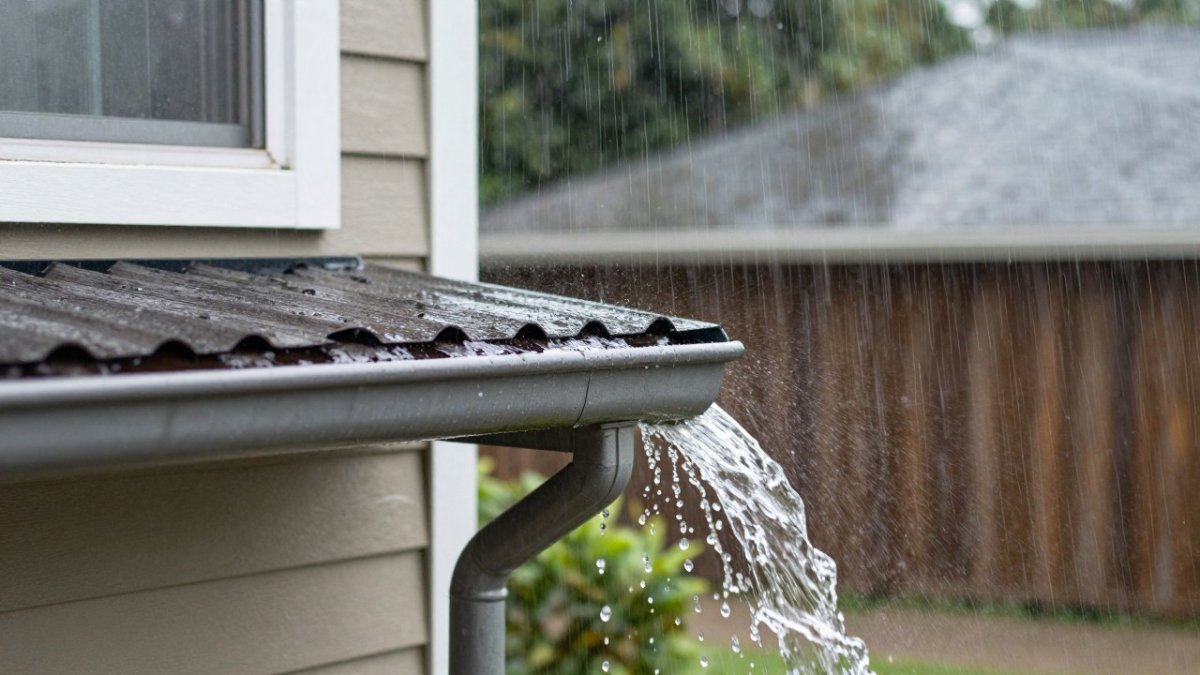
Watch for these failure signs after a storm:
- Water sheeting over the front edge of the gutter instead of entering it
- Overshooting at corners and downspout joints
- Debris pressed flat against the guard, blocking the intake
- Fascia or soffit staining below the gutter line
How We Evaluated the 7 Best Gutter Guards for Heavy Rainfall
Gutter guards can be compared on the same criteria, because a guard that only excels at one thing is a poor fit for a storm-prone roof:
- Water flow capacity: how well the guard passes water into the trough at high rainfall
- Debris protection: how well it keeps out leaves, twigs and fine grit
- Installation fit: whether it suits DIY work or needs a professional
- Total ownership cost: price, warranty and expected maintenance
Gutter Guard Water Flow Capacity Compared
Water flow is the metric that matters most in heavy rain, and it is the one most product pages skip. If running the test feels like too much work, professional gutter installation can handle the setup for you.
A reproducible flow test you can run:
- Mount a 10-foot gutter section at the pitch the guard manufacturer specifies (typically 1/4 inch per 10 feet, but confirm, some guards require flatter or steeper runs).
- Install the guard per the manufacturer's instructions, including any required fasteners or end caps.
- Feed water onto the roof side of the guard at a measured rate. A common approach is to use a hose with a known flow rate (measure it by timing how long it takes to fill a 5-gallon bucket) and adjust the spigot until you hit a target rate.
- Time how long the gutter takes to overflow, or measure how much water exits the downspout versus how much you applied.
- Repeat at three intensities: a steady soak (roughly 1 inch per hour), a heavy storm (roughly 2 inches per hour), and a cloudburst (4 inches per hour or more).
National Weather Service rainfall intensity definitions describe what those rates mean in practice, and they are the bar every guard in this list has to clear.
What the three guard families do under that test:
- High-flow reverse-curve and wide-intake designs move the most water at cloudburst intensity because the open intake does not rely on surface tension or fine filtration. Their weakness is fine debris: pine needles and grit pass straight into the trough.
- Micro-mesh and surface-tension designs filter the finest debris but slow peak flow. The mesh itself is not usually the bottleneck; the bottleneck is the gap between the mesh and the gutter lip, which can choke when sediment mats the surface. Expect these to handle a steady soak well and to struggle at cloudburst rates once the mesh has any buildup.
- Punched or perforated metal covers sit between the two, and their performance depends heavily on hole size and pitch. Larger holes pass more water and more debris; smaller holes filter better and slow flow.
Match the guard to your roof's runoff, not just the rainfall rate. Runoff scales with catchment area, not with the number of gutters.
Ask the manufacturer these questions before you buy:
- At what rainfall intensity was the guard tested, and was the test run with debris on the mesh or on a clean surface?
- What pitch and gutter size does the test assume?
- Does the warranty cover water overshooting the gutter, or only the guard material itself?
Watch out: a guard that passes a clean-mesh flow test can still fail in the first storm of the season, because debris load, not the guard alone, determines real-world capacity.
The three guard families behave differently under the flow test, as summarised below.
| Guard family | Strength in heavy rain | Main weakness |
|---|---|---|
| High-flow reverse-curve and wide-intake | Moves the most water at cloudburst intensity | Fine debris such as pine needles and grit passes into the trough |
| Micro-mesh and surface-tension | Filters the finest debris and handles a steady soak well | Peak flow slows, and sediment buildup on the mesh can choke it at cloudburst rates |
| Punched or perforated metal | Balances flow and filtration | Performance depends on hole size and pitch; larger holes pass more debris |
Best Gutter Guards for Leaves and Pine Needles
Central Florida homes often sit under pines and oaks, so debris protection matters as much as flow. Pine needles are the hard case. Their fine, flexible shape can slip through coarse openings and mat together over the trough.
Micro-Mesh and Pine Needle Performance
Micro-mesh guards keep out pine needles and fine grit well, but they need the most attention in heavy rain. Their fine openings can clog with sediment over time, and cleaning them takes more effort than a coarse guard. In our view, micro-mesh is worth it for homes with heavy needle loads, provided you check the mesh a few times a year.
The 7 Best Gutter Guards for Heavy Rainfall Ranked
- High-flow reverse-curve guard. Wide intake and a curved edge move water quickly into the trough. Best for steep, large roof sections. Skip it if fine debris is your main concern.
- Stainless steel micro-mesh. Excellent debris filtration and corrosion resistance. Best for pine-heavy lots. Skip it if you won't clean the mesh twice a year.
- Aluminum micro-mesh. Lighter and lower cost than stainless steel, with similar filtration. Best for budget-conscious installs. Skip it in coastal areas with heavy salt exposure unless the finish is rated for it.
- Punched (perforated) metal guard. Solid frame with evenly spaced holes. Best for leaves and twigs. Skip it if pine needles are a problem, since they can pass through larger holes.
- Foam insert guard. Low cost and easy to install. Best for light debris. Skip it in heavy rain, because foam can clog and limit flow.
- Surface-tension (bottom-feed) guard. Water clings and drops into the trough, and debris falls off. Best for steep roofs. Skip it if your roof is low-pitched, since water may run off the front instead.
- Hybrid mesh-and-perforated guard. Combines a coarse outer layer with a fine inner mesh. Best for mixed debris. Skip it if you want the simplest, lowest-maintenance option.
Best Gutter Guards for Do It Yourself Installation
Many homeowners install guards themselves to save on labor. Snap-in and clip-on designs suit DIY work on a single-story home with easy ladder access. Covers that need fastening to the fascia or roof edge, or that require precise slope, are better left to a professional.
If you go the DIY route, check the gutter slope first and confirm the guard seats fully. A gap at the joint can send heavy rain straight past the trough.
Pricing, Warranties, and Maintenance Over Time
Guard pricing depends on quantity, materials, and installation, and current pricing is available by contacting SunPro Contracting LLC directly for a quote.
Typical installed cost ranges by guard type (per linear foot, materials plus labor):
Warranty terms to read closely. Most manufacturer warranties cover the guard material against defects, rust-through, cracking, finish failure, for a stated number of years, often 10 to 25. What they typically exclude matters more than what they cover:
- Damage from clogged gutters or improper pitch, which manufacturers treat as an installation or maintenance failure
- Storm damage, including wind uplift and hail
- Water overshooting the gutter, which is usually classified as a performance issue rather than a material defect
- Labor to remove and reinstall the guard for cleaning or repair
Ask for the warranty document before you sign, and read the exclusions section, not the headline term. A "lifetime" warranty that excludes water performance is not a warranty against the problem you are trying to solve.
Maintenance is the hidden cost. No guard eliminates maintenance; the honest question is how often and how hard. In a storm-prone climate with pine or oak cover, plan on:
- Twice-yearly inspection of the mesh or intake surface, plus a check after any major storm
- Annual cleaning of the trough and downspout inlets, because fine grit and shingle granules pass through even micro-mesh
- Replacement of foam inserts every few years, since foam degrades and compresses
- Re-seating or re-fastening of any guard that lifts at a joint, because a gap at the joint sends heavy rain straight past the trough
Failure modes to watch for in heavy rain:
- Debris mats that flatten against the mesh and shed water sideways instead of into the trough
- Sediment clogging in micro-mesh, which is slow and invisible until a storm exposes it
- Corrosion at fasteners and cut edges, especially near coastal salt exposure
- Ice damming in colder markets, where water refreezes at the gutter lip and backs under the guard
- Pitch drift, where a gutter that was correctly sloped sags over time and starts overshooting at the low end
Get a Gutter Guard Assessment for Your Roofline
Choosing the right guard depends on your roof pitch, catchment area, tree cover and how much rain your gutters actually handle. SunPro Contracting LLC offers gutter services, and you can contact the company for an assessment and a quote.
Frequently Asked Questions
What is the number one rated gutter guard?
No single gutter guard wins in every condition, and no ranking should be read as a universal verdict. The right choice depends on your roof, the debris around your home, and how much rain your area receives. Micro-mesh guards generally perform well at keeping fine debris out, while high-flow designs with wider openings are better suited to heavy rainfall because they move water into the gutter faster. Before buying, compare the water-flow specifications and warranty terms for the specific products you are considering, and ask your installer how the guard will handle your roof's catchment area.
Can gutter guards handle heavy rain?
Some can, but performance varies widely. Gutter guards that restrict water entry too much can cause water to overshoot the gutter during intense rainfall, especially where the roof sheds water quickly or the gutter is undersized for the catchment area. High-flow designs and properly sized downspouts reduce this risk. Ask for documented water-flow capacity rather than general claims, and confirm that the installation matches the slope and gutter size recommended by the manufacturer.
Are gutter guards effective against pine needles and leaves?
Gutter guards can reduce the amount of pine needles and leaves entering your gutters, but effectiveness depends on the type. Micro-mesh and fine stainless steel screens tend to keep out small needles and grit, while larger leaves and sticks are usually blocked by most designs. Pine needles can still collect on top of some guards, so periodic clearing of the surface may be needed. Check the manufacturer's debris claims against your specific tree cover.
Is a do it yourself gutter guard installation worth it?
Simple snap-in or screw-down guards can be installed by a homeowner comfortable working at height, but incorrect installation is a common cause of overflow and sagging. Guards that are not seated properly or fastened to the correct slope can channel water over the gutter instead of into it. If your roofline is steep, multi-story, or includes complex sections, a professional assessment is usually the safer choice. SunPro Contracting LLC offers gutter services, and current pricing and availability are available by contacting the company directly for a quote.