 blog
blog
Residential Exterior Painting Services Cost: 2026 Guide
Table of Contents
- What Residential Exterior Painting Services Cost Actually Covers
- Factors Affecting Exterior Painting Price on Every Quote
- Average Cost to Paint a 2000 Sq Ft House and How Size Changes the Number
- How to Calculate Exterior Paint Coverage for Brick Homes
- Regional Price Differences and Climate-Specific Material Requirements
- Hidden Costs: Permitting, HOA Fees, and Site Conditions
- Ways to Save Money on Exterior Painting Without Cutting Prep
- Professional Versus DIY Cost Comparison
- Frequently Asked Questions
Last Updated: September 16, 2026
What Residential Exterior Painting Services Cost Actually Covers
Residential exterior painting services cost is the total price a homeowner pays a professional contractor to prepare, prime, and finish the outside of a house, and it almost never breaks down the way homeowners expect. At SunPro Contracting LLC, we've observed that sticker shock often comes from prep work, not paint.
Labor Versus Material: Where the Money Goes
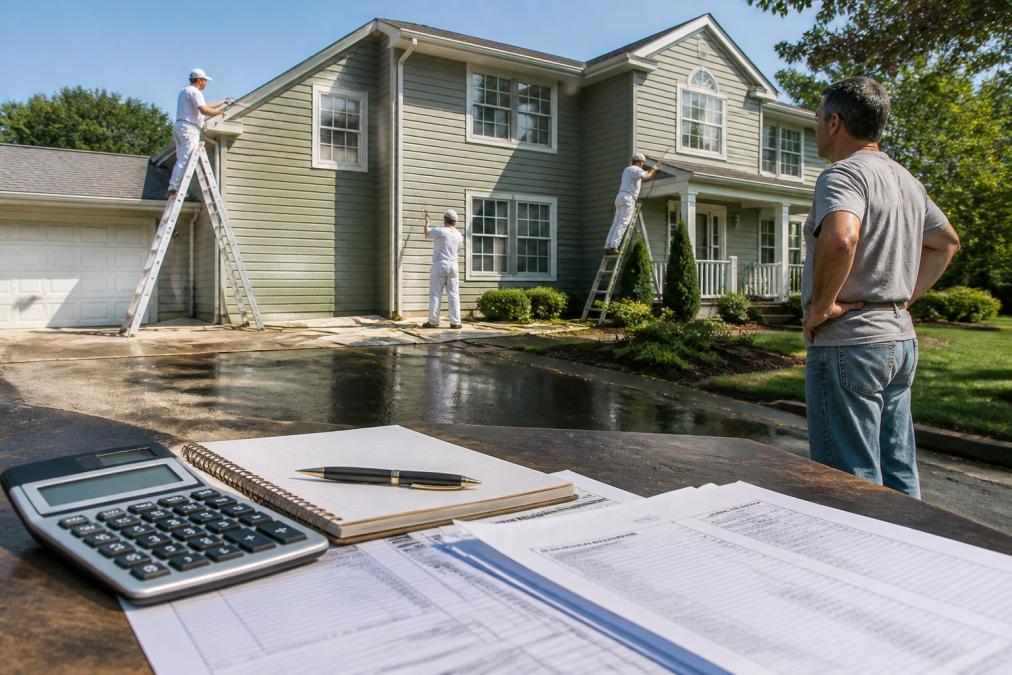
Labor is the largest line on nearly every exterior painting estimate. Paint itself is the cheap part. A common mistake is assuming the reverse, then wondering why two quotes for the same house differ by thousands of dollars. The gap is almost always hours: scraping, sanding, caulking, masking, and spraying or brushing trim.
Why Price Per Square Foot Misleads Homeowners
Price per square foot is a rough starting point, not a final answer. It ignores paintable surface area, which is the actual wall, trim, fascia, and soffit that receives paint. Two homes with identical square footage can have wildly different paintable areas once you subtract windows, doors, and garage openings.
Factors Affecting Exterior Painting Price on Every Quote
Factors affecting exterior painting price come down to access, condition, and surface. A quote built on a flat, reachable, single-story wall is a different job than one built on a steep two-story home with rotted siding. Contractors price risk and time, and both climb fast when the crew needs scaffolding, extensive surface preparation, or specialty primers.
Stories, Height, and Access
Height is the single biggest labor multiplier. A single-story home lets a crew work from the ground and short ladders. A two-story home brings scaffolding, harnesses, and slower movement, and that time shows up directly in the total project budget. Steep rooflines, tight side yards, and landscaping that blocks ladders add more.
Site Conditions, Siding Repair, and Lead Paint Remediation
Site conditions decide how much of the job is painting versus fixing. Power washing, caulking, siding repair, and primer application are prep steps that protect the finish, and skipping them is why paint peels within a year. On homes built before 1978, lead paint remediation is a regulated step, and the EPA lead-safe renovation requirements set the certification and containment rules a contractor must follow.
Average Cost to Paint a 2000 Sq Ft House and How Size Changes the Number
The average cost to paint a 2000 sq ft house depends far more on stories, prep, and trim than on the square footage itself. Size sets the baseline, but everything stacked on top of it moves the number. A simple single-story home with minimal trim sits at the low end of any range.
| Project Factor | Effect on Total Cost | Why It Matters |
|---|---|---|
| Single-story, simple trim | Lower | Ground-level access, faster prep |
| Two-story, steep roof | Higher | Scaffolding, harnesses, slower work |
| Heavy prep and repairs | Higher | Labor hours for scraping and caulking |
| Quality latex paint, premium sheen | Moderate | Higher material cost, longer durability |
| DIY vs. professional | Lower upfront, higher risk | Prep mistakes cause early peeling |
Single-Story Versus Two-Story Homes
Single-story and two-story homes are priced differently because access drives labor. A crew can finish a single-story exterior in far fewer hours than a comparable two-story, even when the total square footage matches. If you're comparing quotes between homes, compare stories first, then square footage, then condition.
How to Calculate Exterior Paint Coverage for Brick Homes
Learning how to calculate exterior paint coverage for brick homes starts with measuring paintable surface area, not the home's footprint. Brick is porous and absorbs paint differently than siding, so coverage per gallon runs lower and primer choice matters more. Measure each wall's height and width, subtract windows and doors, then add trim and fascia separately.
Primer, Sheen, and Paint Grade Choices
Primer and sheen choices change both cost and durability. A quality latex paint in a satin or low-sheen finish holds up better against sun and rain than flat paint, and oil-based primer is often the right call over bare wood or chalky surfaces. Paint grade matters too: entry-level paint saves money now and fades sooner.
Regional Price Differences and Climate-Specific Material Requirements
Regional price differences and climate-specific material requirements push the same house to different totals depending on where it sits, and the gap is large enough that a national average is nearly useless for budgeting. Two forces drive it: local labor rates and the coating system the climate demands.
What Actually Drives Regional Spread
Labor is the biggest regional variable. Metro areas with high demand and a short supply of crews, think dense coastal markets or fast-growing Sun Belt suburbs, carry higher hourly rates and longer lead times than rural areas with more competition. Material distribution matters too: a coating that is stocked locally costs less than one trucked in.
Climate Changes the Coating System, Not Just the Price
Climate does not just nudge the number, it changes which products are correct, and correct products cost more.
- Humid and coastal climates: Moisture and salt air attack caulk, bare wood, and ferrous fasteners. Crews typically specify a masonry or bonding primer plus a mold- and mildew-resistant topcoat, and they may need faster-drying products to hit recoat windows between rain events. Salt exposure near the coast also pushes homeowners toward higher-grade exterior acrylics and stainless or coated fasteners on trim.
- Extreme heat and high-UV climates: Intense sun breaks down cheap binders and fades organic pigments. UV-stable acrylics and lighter colors hold up longer; dark colors absorb heat and can accelerate film failure on siding that expands and contracts.
- Freeze-thaw and wet-cold climates: Substrate movement and trapped moisture drive peeling. Elastomeric or flexible coatings and careful moisture management matter more than brand.
How to Use This Without a National Average
The practical move is to get local quotes and ask each contractor which primer and topcoat they specify for your climate and substrate, then compare those specs, not just the totals. For background on how moisture and sun exposure shorten coating life, the U.S. Department of Energy exterior durability guidance is a useful starting point.
Hidden Costs: Permitting, HOA Fees, and Site Conditions
Hidden costs such as permitting, HOA fees, and unexpected site conditions are the line items homeowners discover last, and they are the ones most guides skip entirely. This section covers the administrative costs and the quote-comparison discipline that keep them from blindsiding you.
Permits: When You Actually Need One
Most repaints that match the existing color and material need no permit. Permits typically enter the picture when the work crosses into structural or regulated territory: replacing siding, altering a facade, or disturbing lead-based paint on a pre-1978 home. Lead-safe work practices are governed by the EPA lead-safe renovation requirements, which set certification, containment, and cleanup rules a contractor must follow.
HOA Approvals: The Cost of Getting It Wrong
Homeowner associations frequently regulate exterior color, finish, and even the sheen. Approval is usually free or a small application fee, but the penalty for skipping it is severe: if the association rejects the color after the job is done, you repaint at your own expense. The sequence matters, get written approval before the crew starts, and confirm whether the association requires a specific product or color palette.
Site Conditions and Mid-Job Discoveries
Rotted fascia, failed caulk, damaged siding, and pest or moisture damage are found once prep begins, not during the estimate walkthrough. A well-written quote states how the contractor handles these discoveries: a per-linear-foot or per-square-foot rate for repair, and whether change orders require your written approval before work continues.
The Apples-to-Apples Quote Checklist
Because quotes are rarely formatted the same way, use a standardized checklist to compare them line by line:
- Pain table surface area and number of stories stated explicitly
- Prep steps itemized: power washing, scraping, sanding, caulking, priming
- Primer and topcoat specified by product name and sheen
- Repair rates for rotted wood, siding, and trim stated per unit
- Lead-safe certification and containment procedures if the home predates 1978
- Permit responsibility and HOA approval responsibility named
- Payment schedule tied to milestones, not a large upfront deposit
- Written warranty terms: duration, coverage, and what voids it
- Change-order process in writing, with your approval required before extra work
Ways to Save Money on Exterior Painting Without Cutting Prep
Ways to save money on exterior painting without cutting prep come down to timing and scope, not skipping steps. Book in the off-season when crews have availability. Handle landscaping and furniture moving yourself. Choose a mid-grade paint with a proven primer instead of the cheapest option. Bundle exterior painting with other exterior services, like gutter work or masonry repair, so one crew handles overlapping prep.
- Get at least three itemized estimates
- Confirm prep steps in writing: power washing, caulking, priming
- Verify lead-safe certification if your home predates 1978
- Check HOA and permit requirements before signing
- Ask how the contractor handles rotted siding found mid-job
Professional Versus DIY Cost Comparison
Professional versus DIY cost comparison usually favors professionals once you count prep, safety, and durability. DIY saves the labor line but adds equipment rental, ladders, and your own time, and prep mistakes cause early peeling that erases the savings. A professional painting contractor brings proper surface preparation, the right primer, and a finish that lasts.
Frequently Asked Questions
How much should it cost to paint a 2000 square foot house exterior?
There is no single number because exterior painting cost depends on paintable surface area, not total square footage. A 2000 sq ft home might have 1,800 to 2,600 sq ft of actual wall surface once trim, soffits, and fascia are counted. Stories, siding material, prep work, and paint grade all shift the total. Get at least three itemized estimates and compare scope line by line rather than the bottom-line number.
Does the number of stories affect exterior painting costs?
Yes, significantly. A two-story home needs taller ladders, scaffolding, or lifts, and those add labor hours and equipment charges. Crews also work slower at height, so the hourly rate effectively rises. A single-story home with the same paintable surface area usually costs less to paint than a two-story home because access is simpler and safer.
What factors increase the cost of professional exterior painting?
The biggest drivers are surface preparation, siding repair, caulking, primer application, and lead paint remediation on pre-1978 homes. Height and access, paint quality and sheen, climate-specific material requirements, and whether trim and fascia need extra attention all raise the price. Permitting and HOA fees can add cost in some neighborhoods.
Is it cheaper to paint a house in the off-season?
Sometimes. Painters in warm climates often have more availability in cooler months, which can mean more flexible scheduling and occasionally better pricing. In cold regions, however, low temperatures can prevent latex paint from curing properly, so the work may need to be delayed. Ask whether the contractor offers any scheduling incentive and confirm the paint can cure at the expected temperature.
Exterior painting rewards preparation, and that is exactly where cheap quotes cut corners. SunPro Contracting LLC brings over 100 years of combined experience to residential and commercial exterior painting, gutter services, and masonry, with fast, budget-conscious service and customized solutions for every property. Get started with SunPro Contracting LLC and protect your home with a finish built to last.